Tap image to enlarge이미지를 누르면 크게 볼 수 있습니다
Application & Purpose작품의 목적
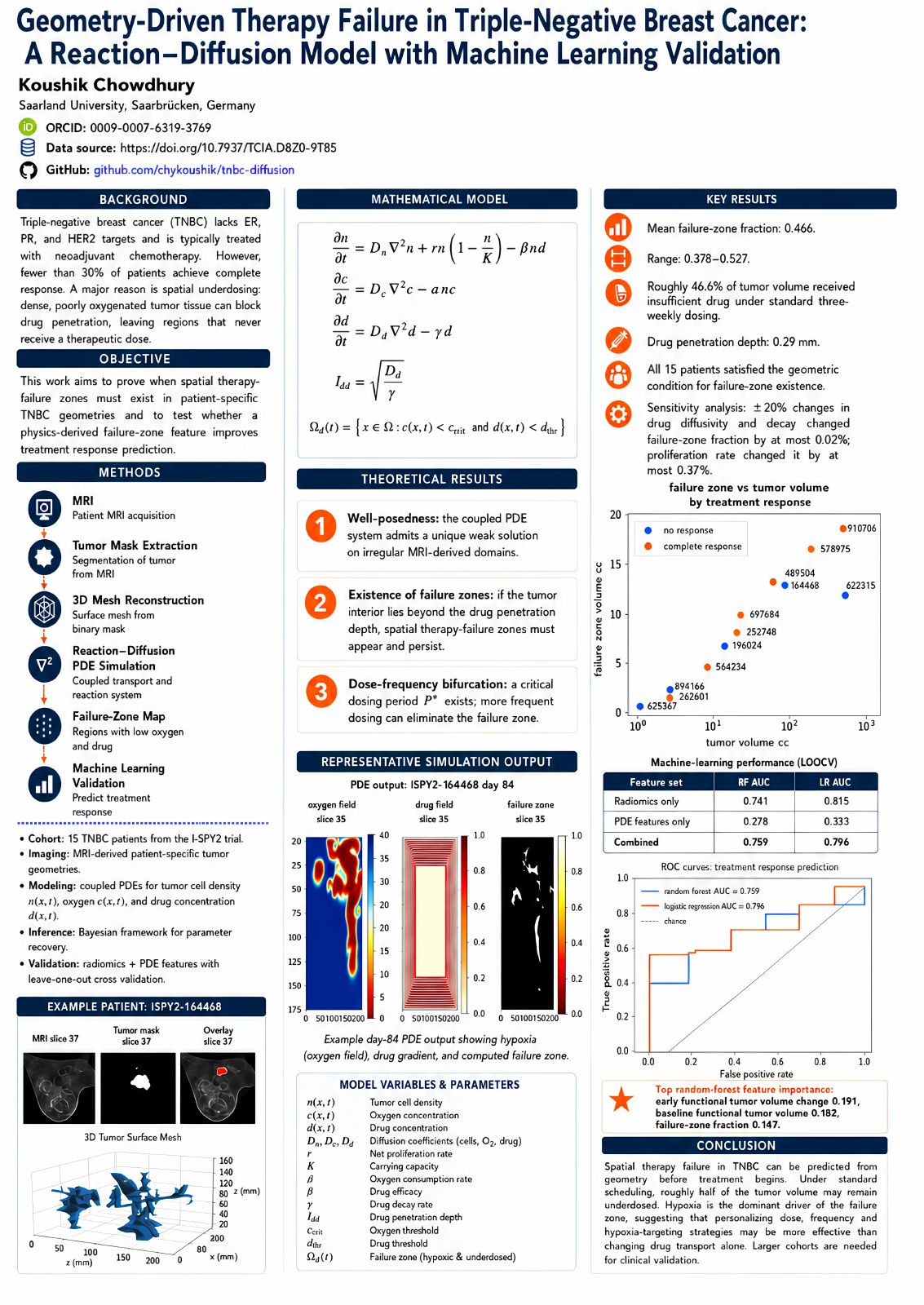
This poster presents a patient-specific framework for explaining chemotherapy failure in triple-negative breast cancer. Using MRI-derived tumor geometries, a coupled reaction–diffusion model identifies hypoxic, drug-insufficient failure zones. Mathematical analysis establishes when these zones must exist, while simulations on 15 I-SPY2 patients and machine-learning validation examine their relationship to treatment response.
이 포스터는 삼중음성 유방암의 화학요법 실패를 설명하는 환자 맞춤 프레임워크를 제시합니다. MRI에서 얻은 종양 기하 구조를 이용해 결합 반응–확산 모델로 저산소·약물 부족 실패 영역을 찾아냅니다. 수학적 분석으로 이 영역이 언제 반드시 존재하는지 밝히고, I-SPY2 환자 15명 시뮬레이션과 머신러닝 검증으로 치료 반응과의 관계를 살핍니다.
AI Tools & WorkflowAI 도구와 작업 흐름
ChatGPT was used to generate the initial poster visuals and layout. The AI-generated scientific graphs were then replaced with original results from the manuscript. Canva was used for final enhancement, alignment, and high-quality PDF export to preserve text clarity when zoomed.
ChatGPT로 초기 포스터 시각 요소와 레이아웃을 생성했습니다. AI가 생성한 과학 그래프는 논문의 원본 결과로 교체했습니다. Canva로 최종 다듬기, 정렬, 확대 시 글자가 선명하도록 고품질 PDF 내보내기를 했습니다.
Process & Iterations제작 과정과 반복
I first extracted the manuscript’s central argument: tumor geometry can create regions where oxygen and chemotherapy both remain below therapeutic thresholds. I then organized the poster around the research sequence: clinical problem, MRI processing, tumor-mask extraction, 3D reconstruction, mathematical model, theoretical results, PDE simulation, and treatment-response validation. ChatGPT was used iteratively to shorten technical explanations, improve visual hierarchy, and make the scientific narrative easier to follow. The original MRI slices, tumor masks, surface reconstruction, failure-zone maps, and machine-learning plots were inserted directly from the research workflow. Several rounds of resizing, alignment, image replacement, spacing, and text reduction were completed. All equations, parameter values, patient results, and conclusions were manually checked against the manuscript before final export.
먼저 논문의 핵심 논지를 뽑았습니다. 종양 기하 구조가 산소와 화학요법 약물이 모두 치료 역치 아래에 머무는 영역을 만들 수 있다는 것입니다. 이어 포스터를 연구 순서대로 구성했습니다. 임상 문제, MRI 처리, 종양 마스크 추출, 3D 재구성, 수학 모델, 이론적 결과, PDE 시뮬레이션, 치료 반응 검증입니다. ChatGPT를 반복 활용해 기술 설명을 줄이고, 시각 위계를 개선하고, 과학 서사를 따라가기 쉽게 만들었습니다. 원본 MRI 슬라이스, 종양 마스크, 표면 재구성, 실패 영역 지도, 머신러닝 플롯은 연구 워크플로에서 직접 삽입했습니다. 크기 조정, 정렬, 이미지 교체, 간격, 텍스트 축소를 여러 차례 거쳤습니다. 모든 수식, 파라미터 값, 환자 결과, 결론은 최종 내보내기 전에 논문과 직접 대조했습니다.
A Researcher's Perspective연구자의 관점
AI helped me transform a technically dense study into a clearer visual narrative, but it could not reliably reproduce scientific graphs, equations, or patient-derived images. I therefore replaced all AI-generated scientific elements with original research outputs. The most useful aspect was rapid experimentation with layout and visual hierarchy. I would advise researchers to use AI for ideation and communication, while carefully verifying every scientific detail and retaining full control over the final evidence.
AI는 기술적으로 조밀한 연구를 더 명확한 시각 서사로 바꾸는 데 도움이 됐지만, 과학 그래프, 수식, 환자 유래 이미지는 신뢰할 만하게 재현하지 못했습니다. 그래서 AI가 생성한 과학 요소를 모두 원본 연구 산출물로 교체했습니다. 가장 유용했던 점은 레이아웃과 시각 위계를 빠르게 실험할 수 있다는 것이었습니다. 연구자들에게는 AI를 구상과 소통에 쓰되, 모든 과학적 세부를 신중히 검증하고 최종 증거에 대한 통제권을 유지하라고 권합니다.
Extended Content확장 콘텐츠
Open link링크 열기Organized by주최·주관


Supported by후원
