Tap image to enlarge이미지를 누르면 크게 볼 수 있습니다
Application & Purpose작품의 목적
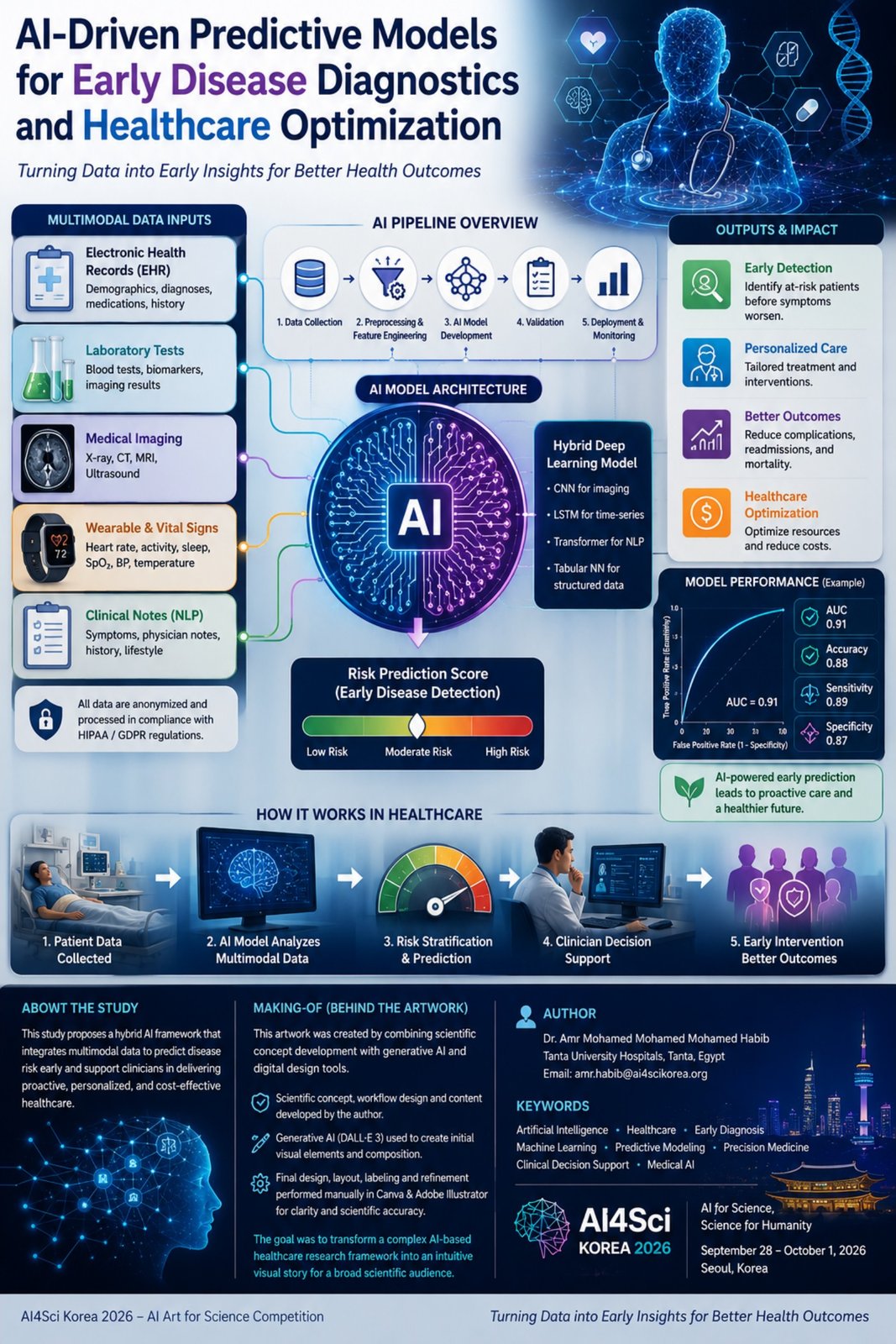
This graphical abstract visualizes an AI-driven framework integrating multimodal clinical data to enable early disease prediction, personalized risk assessment, and healthcare optimization. It transforms a complex computational workflow into an intuitive scientific illustration that supports interdisciplinary communication among clinicians, AI researchers, and healthcare professionals.
이 그래픽 초록은 다중모달 임상 데이터를 통합해 조기 질병 예측, 개인 맞춤 위험 평가, 의료 최적화를 가능하게 하는 AI 기반 프레임워크를 시각화합니다. 복잡한 계산 워크플로를 직관적인 과학 일러스트로 옮겨, 임상의·AI 연구자·의료 전문가 사이의 학제 간 소통을 돕습니다.
AI Tools & WorkflowAI 도구와 작업 흐름
Generative AI was used to create the initial visual composition. The scientific concept, workflow, layout refinement, terminology, and quality control were developed and verified manually to ensure scientific accuracy and clear communication.
생성형 AI로 초기 시각 구성을 만들었습니다. 과학 개념, 워크플로, 레이아웃 개선, 용어, 품질 관리는 과학적 정확성과 명확한 전달을 위해 직접 개발하고 검증했습니다.
Process & Iterations제작 과정과 반복
The artwork evolved through multiple iterations. I first identified the essential scientific components of the research, including multimodal data sources, AI model architecture, predictive analytics, and clinical outcomes. AI-assisted image generation was then used to explore visual concepts. The resulting drafts were repeatedly refined by adjusting composition, hierarchy, labels, icons, and color balance. Scientific terminology was carefully reviewed to maintain consistency with the research while improving readability. The final version emphasizes both scientific rigor and visual accessibility, allowing researchers from different disciplines to quickly understand the proposed AI framework.
작품은 여러 차례 반복을 거쳐 발전했습니다. 먼저 다중모달 데이터 소스, AI 모델 구조, 예측 분석, 임상 결과 등 연구의 핵심 과학 요소를 정했습니다. 그다음 AI 이미지 생성으로 시각 개념을 탐색했습니다. 생성된 초안은 구성, 위계, 라벨, 아이콘, 색 균형을 조정하며 반복해서 다듬었습니다. 과학 용어는 가독성을 높이면서 연구와 일관되도록 세심하게 검토했습니다. 최종본은 과학적 엄밀성과 시각적 접근성을 함께 강조해, 여러 분야의 연구자가 제안된 AI 프레임워크를 빠르게 이해할 수 있게 합니다.
A Researcher's Perspective연구자의 관점
AI dramatically accelerates scientific visualization by converting abstract concepts into compelling graphics within minutes. However, achieving scientific accuracy still depends on expert knowledge and careful revision. My advice to researchers is to treat AI as a creative collaborator rather than a replacement, validating every scientific element before publication.
AI는 추상적 개념을 몇 분 만에 설득력 있는 그래픽으로 바꿔 과학 시각화를 크게 가속합니다. 하지만 과학적 정확성은 여전히 전문 지식과 신중한 수정에 달려 있습니다. 연구자들에게 드리는 조언은 AI를 대체물이 아닌 창의적 협업자로 대하고, 발표 전에 모든 과학 요소를 검증하라는 것입니다.
Organized by주최·주관

Supported by후원
