Tap image to enlarge이미지를 누르면 크게 볼 수 있습니다
Application & Purpose작품의 목적
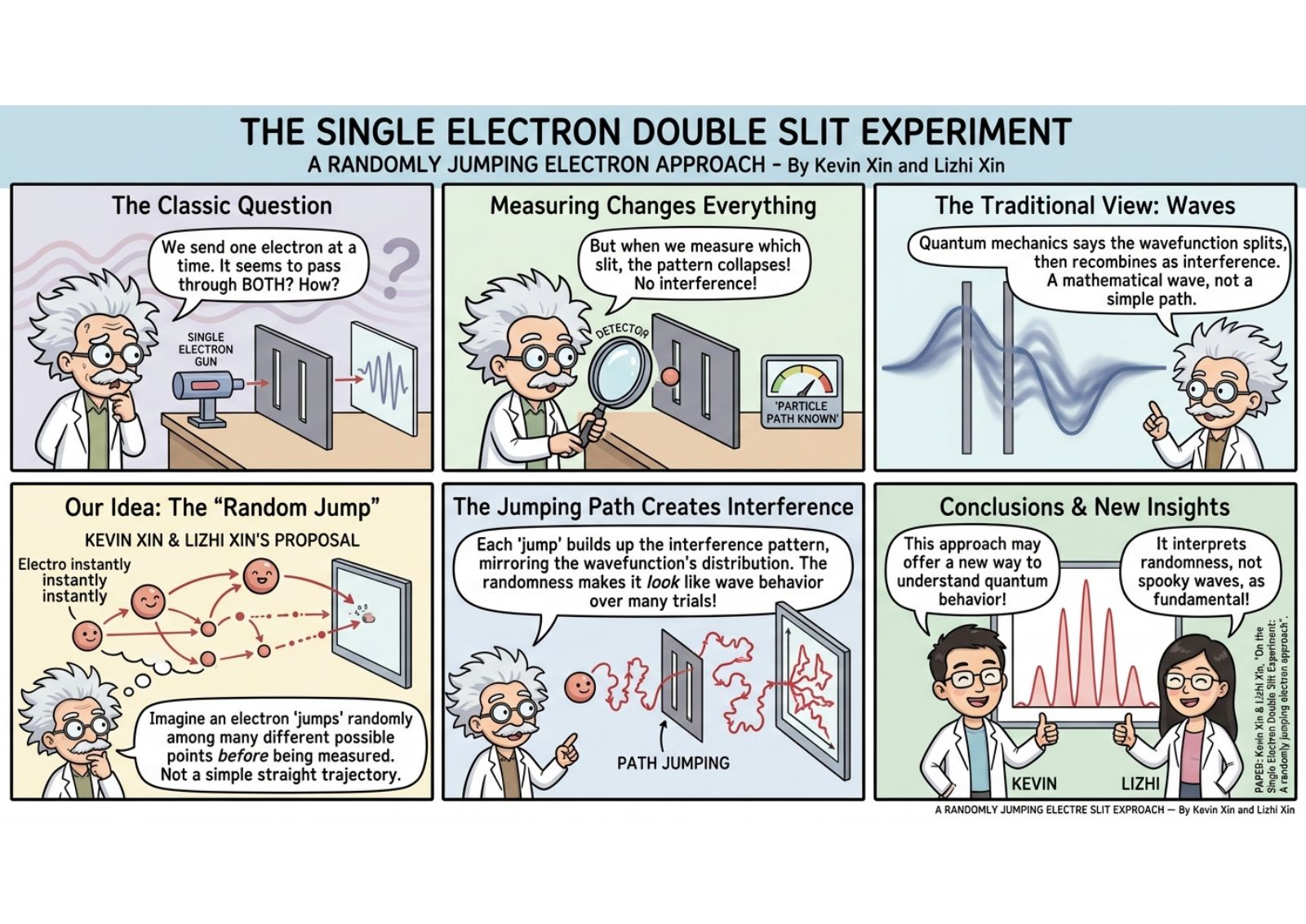
This submission introduces the Randomly Jumping Electron (RJE) Hypothesis, a Monism Ontological framework resolving wave-particle duality paradoxes in the double-slit experiment. Using AI-driven simulations, we demonstrate that discrete, probabilistic particle jumps naturally aggregate to form wave-like interference patterns, offering a simplified, contradiction-free theoretical and visual model for quantum mechanics research and education.
이 작품은 이중 슬릿 실험의 파동–입자 이중성 역설을 해결하는 일원론적 존재론 틀인 무작위 도약 전자(RJE) 가설을 소개합니다. AI 기반 시뮬레이션으로 이산적·확률적 입자 도약이 자연스럽게 모여 파동 같은 간섭 무늬를 이룸을 보여주며, 양자역학 연구와 교육을 위한 단순하고 모순 없는 이론·시각 모델을 제안합니다.
AI Tools & WorkflowAI 도구와 작업 흐름
We utilized AI-driven computational simulations to model discrete electron jumping trajectories and generate empirical comparison datasets. Additionally, generative visual tools were employed to design and structure the panel-by-panel explanatory art poster for submission.
AI 기반 계산 시뮬레이션으로 이산적 전자 도약 궤적을 모델링하고 경험적 비교 데이터를 생성했습니다. 또 생성형 시각 도구로 제출용 패널별 설명 아트 포스터를 설계하고 구성했습니다.
Process & Iterations제작 과정과 반복
Our workflow integrated theoretical physics modeling with iterative AI-assisted visual design. Simulations: We first developed computational algorithms to model discrete electron jumping probabilities, verifying that cumulative particle hits successfully generated standard interference fringes. Visual Conceptualization: We mapped these results into a six-panel narrative poster comparing traditional paradoxes against our Monism Hypothesis. Iterative Refinement: Using visual generation tools, we conducted extensive layout iterations. We continuously refined character placement, diagram flow, textual clarity, and panel arrangements (swapping pathway diagrams and adjusting text blurbs) to eliminate whitespace and balance visual storytelling with scientific accuracy. The final submission represents a refined synthesis of computational physics, clear terminology, and optimized visual communication.
이론물리 모델링과 반복적인 AI 보조 시각 디자인을 통합한 작업이었습니다. 시뮬레이션: 먼저 이산적 전자 도약 확률을 모델링하는 계산 알고리즘을 개발하고, 누적된 입자 충돌이 표준 간섭 무늬를 만들어 냄을 확인했습니다. 시각 구상: 이 결과를 전통적 역설과 우리의 일원론 가설을 비교하는 6패널 서사 포스터로 옮겼습니다. 반복 개선: 시각 생성 도구로 광범위한 레이아웃 반복을 수행했습니다. 캐릭터 배치, 도식 흐름, 텍스트 명료성, 패널 배열(경로 도식 교체와 텍스트 조정)을 계속 다듬어 여백을 없애고 시각적 스토리텔링과 과학적 정확성의 균형을 맞췄습니다. 최종 제출물은 계산물리, 명확한 용어, 최적화된 시각 소통의 정제된 종합입니다.
A Researcher's Perspective연구자의 관점
Translating complex quantum concepts into AI visuals was surprisingly effective for rapid layout drafting, making abstract ideas immediate. However, precise visual control felt limiting—minor text errors, spatial alignment, and fine details often required persistent re-prompting rather than simple tweaks. To fellow researchers: use AI as a creative partner for conceptual scaffolding, but prepare to balance its speed with meticulous oversight to maintain scientific accuracy.
복잡한 양자 개념을 AI 시각물로 옮기는 것은 빠른 레이아웃 초안 작성에 놀랍도록 효과적이어서 추상적 아이디어를 즉각적으로 만들어 주었습니다. 하지만 정밀한 시각 통제는 제한적이었습니다. 작은 텍스트 오류, 공간 정렬, 세부는 단순한 조정이 아니라 끈질긴 재프롬프팅이 필요했습니다. 동료 연구자들에게: AI를 개념 구성의 창의적 파트너로 쓰되, 과학적 정확성을 위해 그 속도와 꼼꼼한 감독의 균형을 맞출 준비를 하세요.
Organized by주최·주관



Supported by후원
